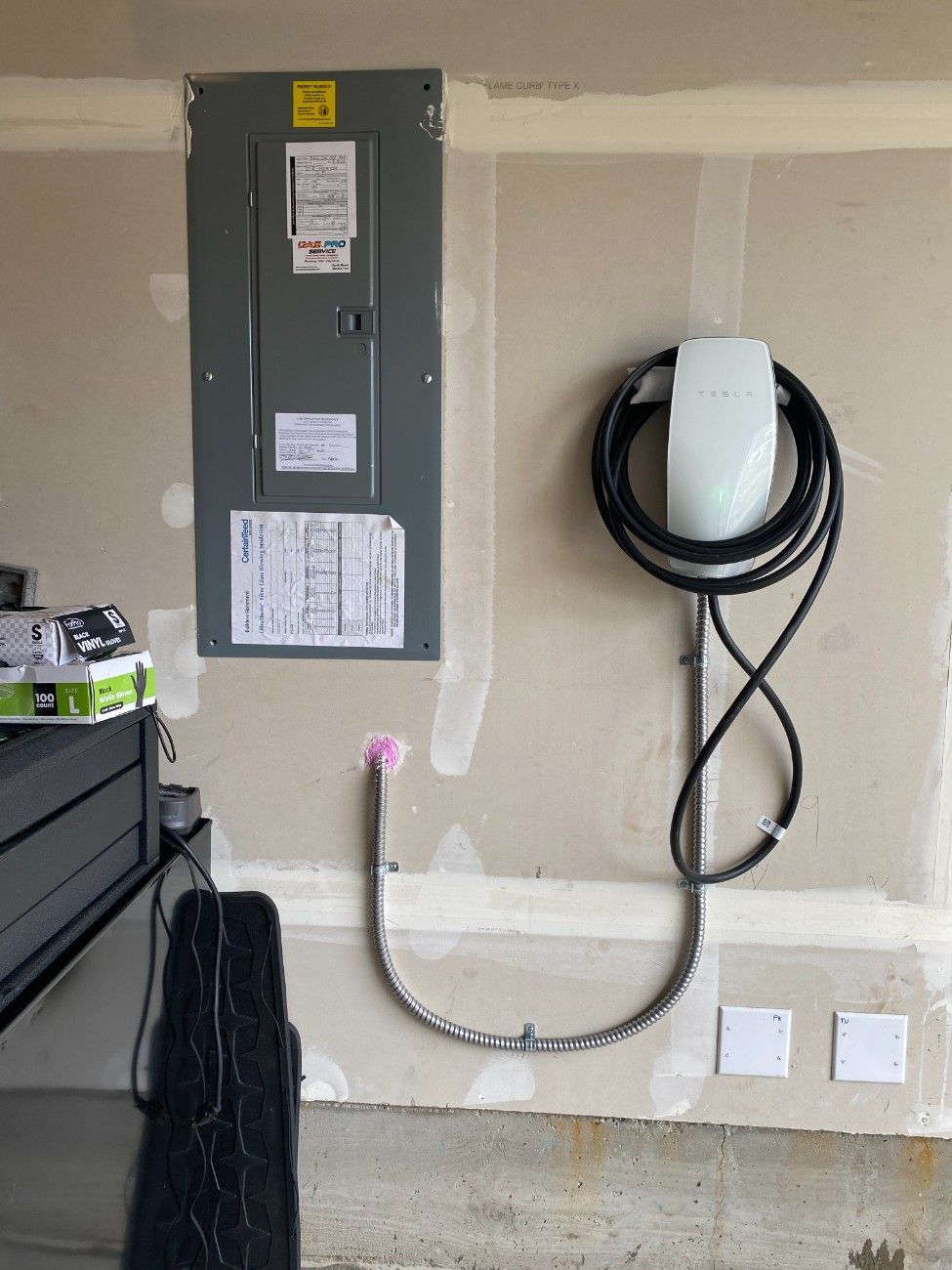
Can Solar Power an EV Charger at Home? A Clear Guide With Simple Calculations
Solar and EV charging go together well, but there are two different questions people mix up.
- First question: Do you make enough solar energy over a full day to cover the energy your EV needs?
- Second question: Can your solar produce enough power at one moment to run a Level 2 charger while your home is also using electricity?
This guide explains both using the same simple inputs you’d use in a basic calculator.
Solar → EV Charger Feasibility Calculator
Checks both daily energy (kWh) and instant power (kW). This is a planning estimator (real output varies by season, shading, roof angle, temperature, etc.).
What you’re actually trying to solve
Daily Energy Check & Instant Power Check
Over the course of a day, can my solar produce enough energy to cover my EV charging needs?
If yes, you may be able to cover the EV energy cost with solar, especially if you have net metering. Net metering means you can send solar to the grid during the day and “buy it back” later when you charge at night, depending on your utility’s policy.
In real time, can my solar run the charger at full speed while the house is also drawing power?
If yes, you can often charge directly from solar during sunny hours.
If no, charging can still happen, but the charger will pull the difference from the grid, or from a battery if you have one.
kW (kilowatts) is power
Power is how fast electricity is being used or produced at one moment.
- Your solar array has a kW rating.
- Your EV charger has a kW rating.
- Your home load at a moment is also measured in kW.
If you try to run a 7.2 kW charger while your home is using 1.5 kW, you need about 8.7 kW of power available at that moment.
kWh (kilowatt hours) is energy
Energy is how much electricity you used or produced over time.
- Your EV battery consumption is in kWh.
- Your solar production per day is in kWh.
If you drive enough miles to use 10 kWh and your solar makes 25 kWh that day, you produced more than your EV needs in energy terms.
Peak sun hours is a planning tool
Peak sun hours is not the number of daylight hours.
- It’s the number of hours per day that your location receives the equivalent of full sun at 1,000 W/m², used for estimating solar output.
- A winter day might be closer to 2 to 3 peak sun hours.
- A strong summer day might be closer to 5 to 6 peak sun hours.
System efficiency is real world derate
- Solar panels do not deliver their full nameplate rating all the time.
- Inverters, wiring, panel temperature, and other factors reduce usable output.
- A common planning range is 0.75 to 0.85.
Step 1: Estimate how much energy your solar produces per day
This is the daily energy check.
Solar daily production is estimated like this: Solar kWh per day = Solar array size (kW) × Peak sun hours (hours per day) × Efficiency
Example:
An 8 kW system
4 peak sun hours
0.80 efficiency
Daily solar ≈ 8 × 4 × 0.80 = 25.6 kWh per day
That number is the solar energy available for everything, including your home and your EV.
Step 2: Estimate how much energy your EV needs per day
This is also part of the daily energy check.
EV energy needed depends on how many miles you drive and your vehicle efficiency.
EV kWh per day = EV miles per day ÷ Miles per kWh
Example:
30 miles per day
3.2 miles per kWh
EV energy ≈ 30 ÷ 3.2 = 9.4 kWh per day
Now you can compare solar production vs EV energy demand. If solar kWh per day is higher than EV kWh per day, your solar can cover the EV energy demand in a simple planning sense. That does not mean it covers your entire home, it only answers the EV part.
Step 3: Estimate how long the charger must run
This helps you understand charging time and whether midday charging is realistic.
Charging time needed (hours) = EV kWh per day ÷ Charger power (kW)
Example:
EV energy: 9.4 kWh per day
Charger: 7.2 kW
Time ≈ 9.4 ÷ 7.2 = 1.3 hours per day
That means if you can plug in during sunny hours for about an hour and a half, you can often replace daily driving on many vehicles.
Step 4: Check if solar can run the charger in real time
This is the instant power check.
You compare solar power available during strong sun to your charger power plus your home load.
Required power (kW) = Charger kW + Home load kW
Example:
Charger: 7.2 kW
Home load: 1.5 kW
Required power ≈ 8.7 kW
Now compare that to the solar power you can actually use.
A simple planning estimate for near peak solar power is:
Solar usable kW ≈ Solar kW × Efficiency
Example:
8 kW solar × 0.80 efficiency ≈ 6.4 kW usable
In this example, 6.4 kW is less than the 8.7 kW needed, so solar alone will not hold the charger at full power and support the house at the same time. The grid or a battery would supply the shortfall. This is why many homes still benefit from net metering even if they can’t charge directly from solar at full speed.
What to do if the power check fails
You can still “charge with solar” through net metering
Many homeowners generate solar by day and charge at night. The grid acts like your buffer. Your solar reduces the total energy you buy over time, even if the charger is not literally powered only by solar in real time. If you’re planning an EV charger install, the MAS Pro team can review your setup, confirm panel capacity, and install the charger safely and to code.