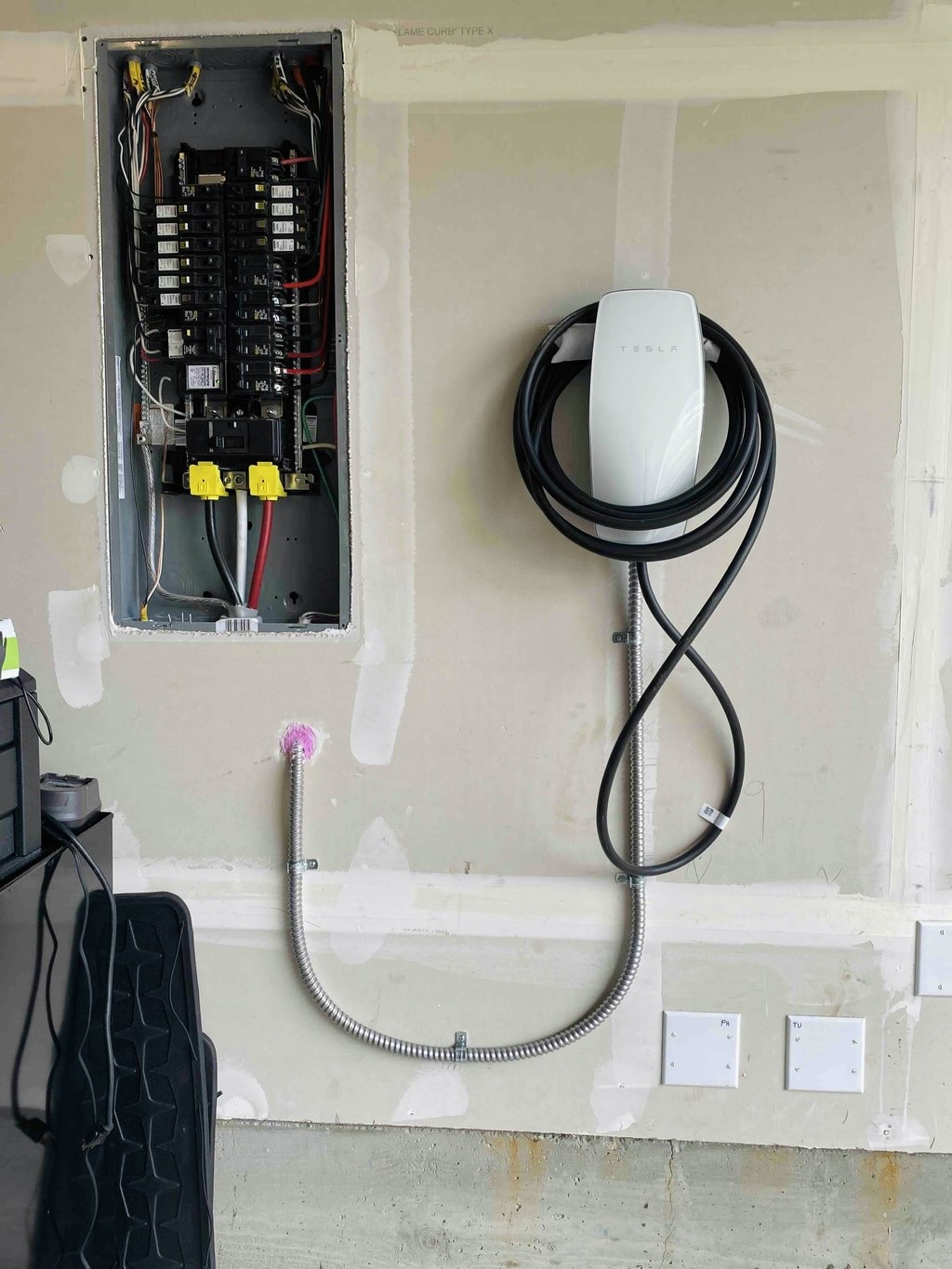
Learn what it costs to install a Level 2 home EV charger, including Tesla chargers, and what factors affect the final price.
As EVs become more common, a lot of homeowners are adding a charger at home. The total cost depends on your house, your electrical panel, and where you want the charger installed. Here’s a clear breakdown of what drives the price (with a focus on the Pacific Northwest).
Typical cost to install a home EV charger
For most homes, a professionally installed Level 2 charger ends up around $2,500 total (labor + materials + the charger). The final number can be lower or higher depending on your setup.
- Level 2 is the most common home option. It usually charges an EV in about 4–10 hours (often overnight). Bigger batteries take longer.
- Level 1 chargers plug into a normal 120V outlet. They’re inexpensive, but slow (often a couple days to fully charge). This is commonly the charger that comes with the vehicle.
- Level 3 (DC fast charging) is what you see in public charging stations. It’s rarely installed at homes because of cost and infrastructure requirements.
What affects EV charger installation cost?
1) Charger type (Level 1 vs Level 2)
Level 1 (120V): cheapest, slowest, usually no installation beyond verifying the outlet circuit is safe.
Level 2 (240V): fastest and most practical for daily use. Costs come from running a dedicated 240V circuit, breaker, wiring, and labor.
2) Plug-in vs hardwired connection
Plug-in Level 2: needs a 240V outlet. If you already have the right outlet in the right place, the install can be simpler. If not, an electrician still has to add it.
If a 240V outlet can be added without major changes, it’s often $250–$800 for the outlet portion (varies by distance and access).
Plug-in chargers typically require a GFCI breaker by code, which can cause nuisance tripping in some setups.
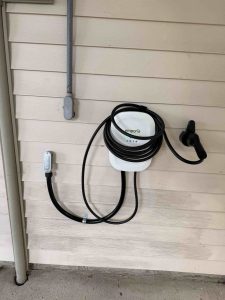
Hardwired Level 2: permanently connected. This is often the more dependable option and can work well outdoors with proper weatherproofing.
Hardwired installs commonly land around $850–$1,800, assuming your panel has capacity.
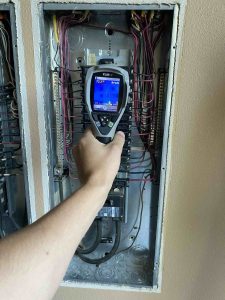
3) Electrical panel capacity and upgrades
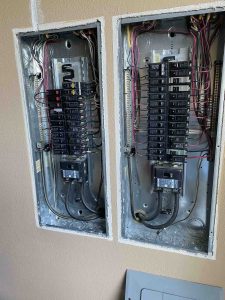
If your electrical panel is full, undersized, or can’t handle the added load, costs increase. Examples include:
adding a subpanel
upgrading the main panel
These upgrades often add $650–$2,000+, depending on what’s needed.
4) Distance and location (garage vs outdoors)
Garage installs are usually cheaper because the wiring run is shorter and weatherproofing isn’t needed.
Common range: $800–$1,500
Outdoor installs may require weather-rated equipment, conduit runs, and extra labor.
Common range: $800–$2,500 depending on complexity
5) Charger brand and hardware cost
The charger itself usually isn’t the main cost driver.
Tesla wall connector: often around $450
Universal chargers (ChargePoint, JuiceBox, etc.): often around $600
(Prices vary by model and sales.)
6) Permits and inspections
Permits and inspections vary by city/county in Oregon and Washington. A typical combined range is $50–$300.
7) Rebates and tax incentives
Some utilities and programs offer rebates (sometimes up to $1,000) for qualifying chargers and installs. Programs change, so it’s worth checking local utility and state options.
Commercial EV charging
At Mas Pro Service, we also handle commercial EV charging projects—everything from service sizing to conduit runs, panel work, and complete charging station installs for employee lots, customer parking, and new construction. If you’re planning an EV charger install, the MAS Pro team can review your setup, confirm panel capacity, and install the charger safely and to code.