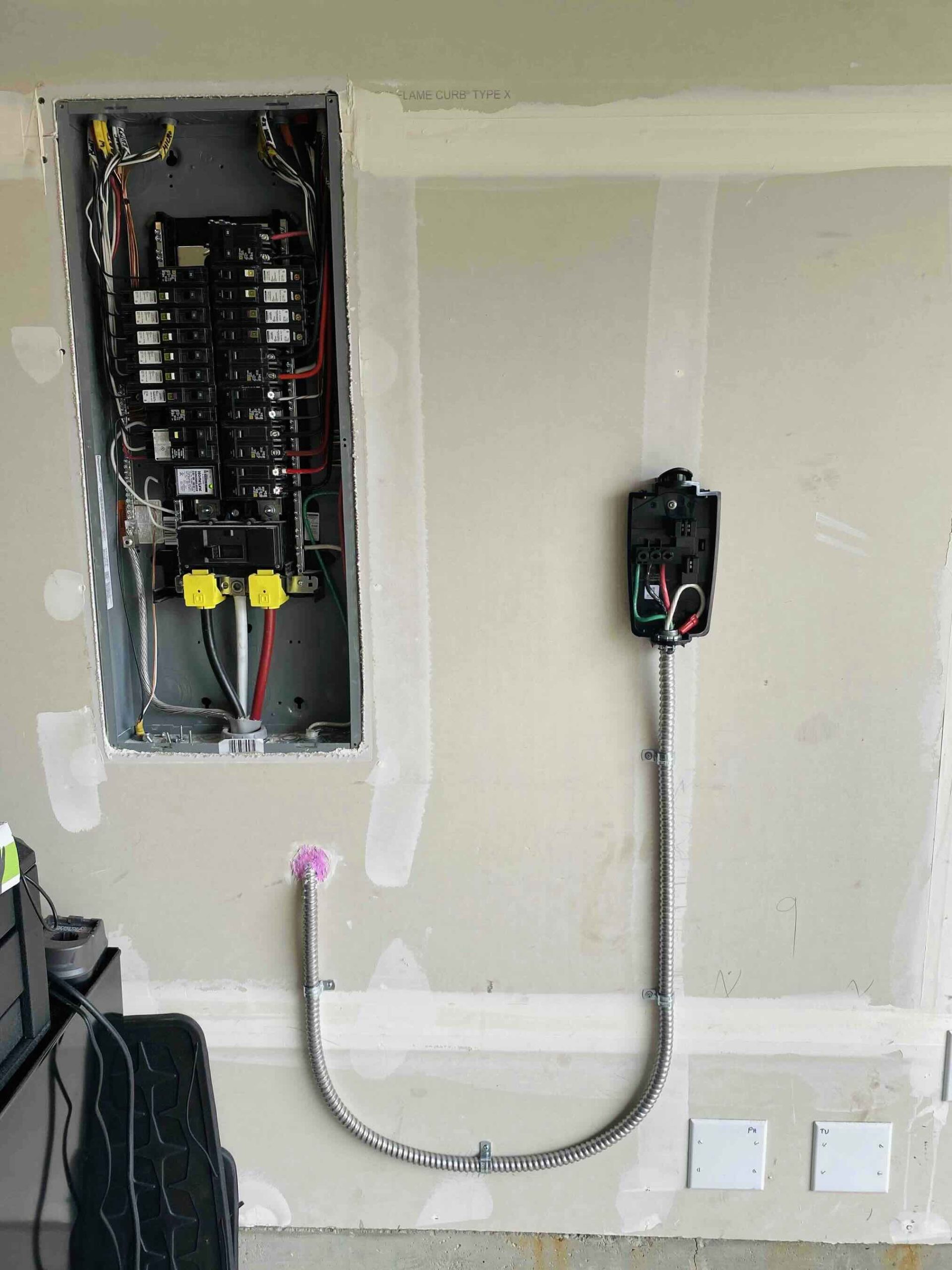
EV chargers are the most power-hungry appliances you’ll ever install. They run continuously for extended periods, carrying high-voltage electrical loads that, if not handled properly, can cause damage to your car and even be a fire hazard.
As such, you’ll need to make sure that both your home’s electrical system and the wiring you use to connect the charger to it – if you go with a Level 2 charger – can handle the load.
Electrical Requirements for EV Chargers
Electrical Panel Requirements
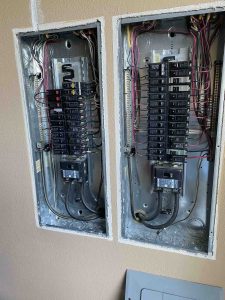
Before getting an EV charger, you need to make sure that your electrical panel has the capacity for one, both in terms of power and space for a new breaker.
If you live in a newer home, power shouldn’t be a problem. Most run on a 200-amp service, which is more than enough power to install a Level 2 charger. Older homes are not so lucky. They typically have 60–100-amp service, which works fine for lower-powered chargers but not if you’re looking for something more robust.
Once you know your home can handle the load, it’s time to purchase the wiring that will link your charger to your electrical panel.
EV Charger Electrical Wiring Gauge
In an ideal situation, an 8 AWG (American Wire Gauge) can handle the load of a lower amperage charger just fine, and a 6 AWG can handle a high amperage charger. However, there is more to figuring out which wires to use than the output of your charger.
The size of your wires will mostly depend on the max amperage of your charger and the distance between it and your electrical panel. A general rule of thumb is to size up the wire by 125% of the charger’s max amperage to keep it from overheating and to account for voltage drops.
| AWG | Maximum Amperage Copper Can Carry at… | ||
| 140°F (60°C) | 167°F (75°C) | 194°F (90°C) | |
| 12 | 20 | 25 | 30 |
| 10 | 30 | 35 | 40 |
| 8 | 40 | 50 | 55 |
| 6 | 55 | 65 | 75 |
| 4 | 70 | 85 | 95 |
| 3 | 85 | 100 | 115 |
| 2 | 95 | 115 | 130 |
| 1 | 110 | 130 | 145 |
If you do size up, make sure that any connected EV charger accessories (circuit breakers/disconnects) are rated for the new wire size.
Grounding, Bonding, and Protection Devices
Given how power is constantly travelling between your electrical panel and charger, it’s important to have safeguards in place:
- Ground Fault Circuit Interrupter (GFCI) breakers automatically shut off your power when there is a fault, preventing potentially fatal electric shocks. Most modern chargers have internal protection (CCID), but an extra layer of safety is always good. In some areas, it’s even mandatory.
- Residual Current Devices (RCDs) are designed to detect earth leakage by constantly balancing the current between live and neutral wires. If there is an imbalance, an RCD will cut off power instantly. They need to be tested every few months.
- Charge Circuit Interrupting Devices (CCID) are built into more modern EV chargers. They monitor electrical flow and prevent electric shocks, fire hazards, and potential vehicle damage. They’re designed specifically for detecting lower-level leakage.
- Insulation Monitoring Devices (IMD) monitor the insulation resistance between ungrounded electrical systems and the earth by injecting a low-frequency signal to detect faults.
- Surge Protection Devices (SPDs) protect against voltage spikes caused by grid fluctuations and lightning strikes by diverting excess current to the ground.
Indoor vs Outdoor EV Charger Electrical Wiring
The last thing to consider is where you’re going to put your charger: inside or outside? Both come with their own benefits and challenges.
| Indoor | Outdoor |
| A simple set-up with shorter unprotected cables running between the home’s electrical panel and the charging station. The garage acts as shelter against the elements. | Set-up might be more complicated, with longer cables requiring protection either through weather-rated conduits or underground trenches. |
| Secure | Chance of vandalization and theft |
| Cable management is easier. | Charging cable needs to be securely stored to prevent wear, tangling, and possible damage. |
| You’re limited by location (garage) and wall space. | Besides wiring length and the size of your yard, there are few limitations on space or placement. |
The electrical wiring in an EV charger can get complicated, especially if you don’t know what you’re doing, but MAS Pro has a team of experts ready and waiting to help you. Give us a call.
What to Look for in a Good Electrical Contractor
When choosing a residential electrician in Ridgefield or Clark County, look for a company that is:
Licensed and qualified
Your electrician should be properly licensed, trained, and equipped to perform residential electrical work safely and correctly.
Experienced in home electrical systems
A strong contractor should know how to troubleshoot existing wiring, identify risks, and recommend practical solutions based on your home’s needs.
Focused on safety and code compliance
Electrical work should meet current code requirements and be completed with long-term reliability in mind, whether it is a repair, upgrade, or new installation.
Clear and professional in communication
Look for a contractor who explains the problem clearly, outlines the work in plain language, and sets honest expectations from the beginning.
Able to handle a wide range of residential services
Homeowners often need more than one solution over time. It helps to work with a company that can assist with generator installation, electrical panel upgrades, lighting installation, outlet installation, and other general electrical services in Ridgefield, WA.
MAS Pro Services is Your Trusted Residential Electrical Services in Ridgefield and Clark County
If you are looking for dependable electrical services in Ridgefield, WA, MAS Pro Services can help with everything from emergency electrical repairs to generator installation, panel replacement, EV charger installation, lighting installation, and electrical outlet installation.
Contact Mas Pro today to schedule an electrical safety inspection!