Skip to content
If your cooling system suddenly fails, knowing what to check, what repairs typically cost, and when to call for emergency AC repair in Camas, WA can help you respond quickly and avoid unnecessary stress.
Check These Things Before You Call
Before you start contacting an HVAC technician for emergency service, there are a few basic checks you can do on your own. They take two to five minutes and occasionally turn out to be the entire problem.
Start at the thermostat. Confirm that it is set to cooling mode and that the target temperature is lower than the current indoor reading. A thermostat accidentally switched to heating or fan-only is a more common cause of a non-cooling system than most people expect. If you have a programmable or smart thermostat, also check whether a scheduled setting has overridden your current preference.
Next, check the circuit breaker. An AC system that has tripped a breaker shuts off completely, and the fix may be as simple as resetting it. Find your breaker panel and look for any breaker labeled AC, condenser, air handler, or HVAC that is sitting in the tripped position, typically between the on and off positions rather than firmly in either direction. If you are comfortable doing so, reset it by pushing it fully to off and then back to on. If the breaker trips repeatedly, it’s usually a sign that there’s a larger problem with the electrical load or equipment. Continuing to try to reset it can cause more damage. A qualified HVAC technician assess the wiring and components to check if the problem extends beyond the breaker itself.
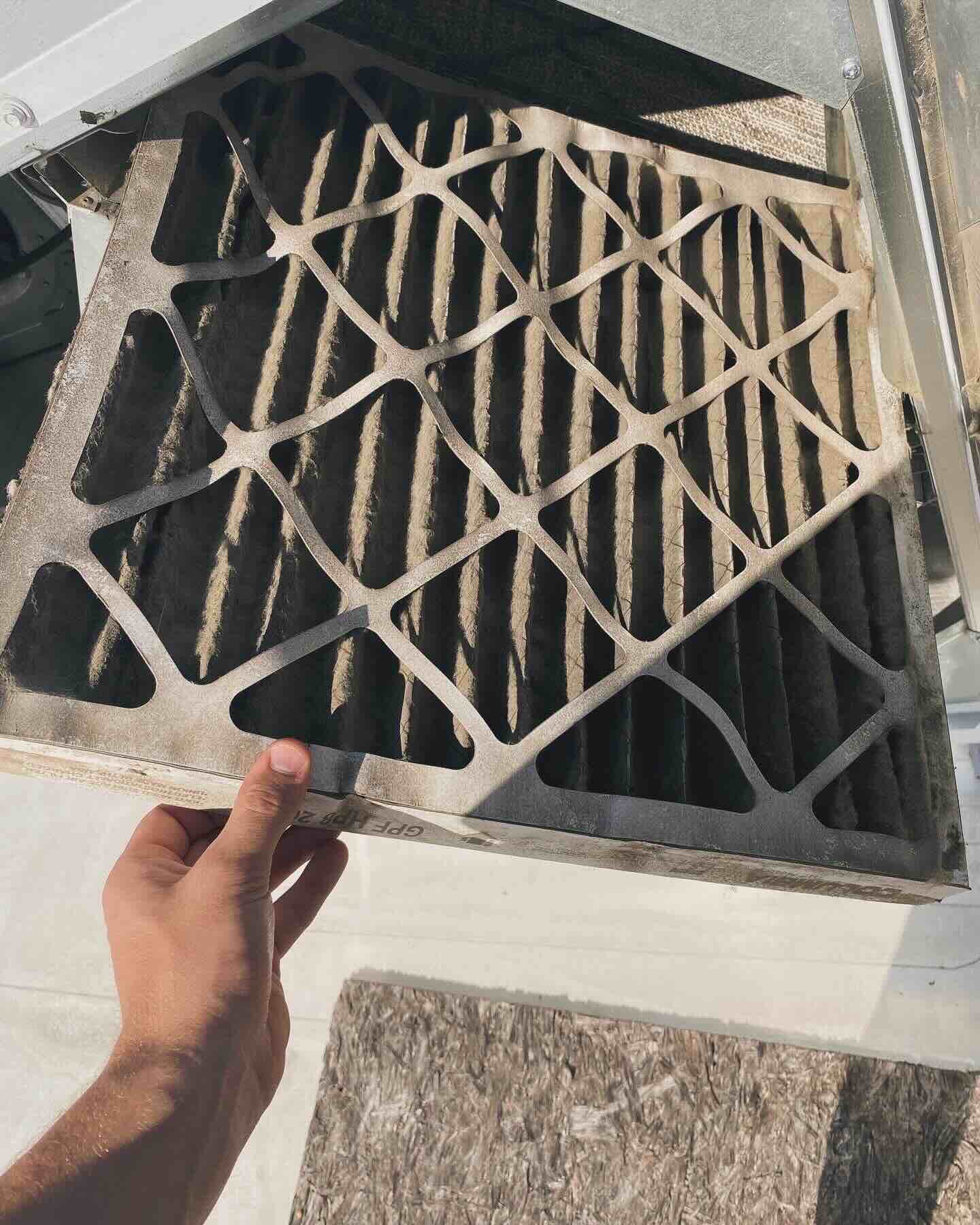
Also check the air filter. A heavily clogged filter restricts airflow enough to freeze the evaporator coil, causing the system to run without producing meaningful cooling. If the filter is visibly packed with debris, replace it and let the system sit for thirty to sixty minutes to thaw before restarting. This is not the cause of most complete system failures, but it takes almost no time to rule out.
What Causes AC Systems to Fail During Summer Heat
Emergency AC repair calls in Camas, WA tend to spike during the first serious heat wave of summer, when systems that handled mild spring weather without any difficulty are suddenly asked to hold a home at 72 degrees while outdoor temperatures climb into the high 90s. That sustained demand is precisely where marginal or aging components give out.
Capacitor failure is one of the most common causes of a sudden AC shutdown. The capacitor provides the electrical boost that compressor and fan motors need to start and run. A capacitor that is gradually weakening may function adequately on cooler days but fail when heat pushes those motors to operate at full load. When the capacitor goes, the compressor or fan motor simply does not start, which causes the system to either shut down entirely or circulate uncooled air. This is one of the faster repairs a technician can complete when they are carrying the right part on the truck, which most do for exactly this reason.
Refrigerant issues are the other leading cause of summer failures. A slow leak that has been developing over months may go unnoticed during light springtime use, but it will become apparent once the system is running long hours under summer load. Low refrigerant reduces cooling capacity, forces the system to run longer to compensate, and eventually causes the evaporator coil to freeze or the system to cycle off on a low-pressure safety switch. If your system is producing air that is noticeably less cold than it should be, or if you can see ice forming on the copper lines near the outdoor unit, refrigerant is likely the issue.
Electrical failures in components like the contactor or in wiring connections are also more common during hot weather, particularly in older systems. Heat accelerates the breakdown of electrical insulation, and connections that have been marginal all year can fail when pushed under summer conditions. This is one of the primary reasons that pre-season HVAC maintenance catches problems before they become emergencies.
What Emergency AC Repair Costs in Camas, WA
AC repair in Camas, WA on a same-day or after-hours basis costs more than a scheduled call, and understanding why helps you evaluate what you are being quoted. The premium for emergency service reflects the logistics of dispatching a technician quickly (often from an on-call rotation rather than a regular shift) rather than a markup on the repair itself. Legitimate HVAC contractors will give you the after-hours rate before any work begins and will not change the cost of parts or labor, only the service fee.
Diagnostic fees for emergency service in Camas typically run between $100 and $200, compared to $75 to $150 for a scheduled appointment. If the repair is completed on the same visit, that fee is usually credited toward the total. The repair cost does not change based on whether the call is emergency or scheduled. A capacitor replacement typically runs $150 to $350, while a refrigerant recharge combined with leak repair typically ranges from $200 to $1,500, depending on the severity of the leak and the amount of refrigerant needed.
Be cautious of any contractor who pushes for full system replacement without a proper diagnosis, or who quotes a large flat emergency fee without explaining what it covers. Emergency situations are unfortunately a common context for overselling. An honest technician diagnoses the problem first, presents the specific repair with pricing, and gives you the choice.
How to Keep Your Home Manageable While You Wait
Depending on how quickly a technician can reach you, there may be a window of several hours where you’ll need to manage without air conditioning during hot weather. A few practical steps can make a real difference during that time:
- Close blinds and curtains on south and west-facing windows.
- Direct sunlight through glass is one of the largest drivers of indoor heat gain during afternoon hours, and blocking it reduces the rate at which your home heats up.
- Run ceiling fans in occupied rooms. Moving air does not lower the room temperature, but it increases the rate at which your body can cool itself, which makes the space feel more tolerable.
- Move to the lowest floor of your home if possible, since hot air rises and upper floors can be significantly warmer than ground-level rooms during a heat event.
If indoor temperatures are reaching levels that pose a risk to anyone in the home, do not wait for the repair. Clark County Public Health maintains an updated list of cooling locations during heat advisories, and those resources are available for exactly this situation. Anyone who is elderly, very young, or managing a health condition should not be kept in extreme indoor heat while waiting for a technician to arrive.
What to Expect During the Service Visit
A qualified HVAC technician arriving for an emergency call will start with a diagnostic assessment before touching anything. That means checking thermostat settings and electrical connections, measuring voltage and amperage at the major components, testing the capacitor and contactor, checking refrigerant pressure, and inspecting the evaporator coil and condensate drain. The diagnosis identifies the actual cause of the problem and allows the technician to quote the repair accurately.
Once the problem is identified, you will receive a repair quote before any work is authorized. Straightforward repairs like a capacitor or contactor replacement can often be completed in under an hour if the technician has the right part on the truck. A refrigerant recharge takes longer because the leak must be located and repaired before the system is recharged. More complex repairs involving the compressor or coil may require a follow-up visit if parts need to be ordered.
It is worth asking the technician for a brief overview of the rest of the system while they are on site. If the system that just had an emergency repair also shows a secondary capacitor that is weakening, or a refrigerant pressure that suggests another slow leak developing, knowing that now is far better than discovering it during the next heat event.
How to Avoid Emergency Calls Next Summer
The most reliable way to avoid emergency AC repair in Camas, WA is a pre-season maintenance visit scheduled in late spring, before the first heat events of the year. A standard tune-up covers refrigerant pressure, coil condition, electrical component testing, condensate drain clearing, and filter inspection. It costs significantly less than an emergency service call and catches the capacitor that is about to fail, the refrigerant level that is slowly dropping, and the drain that is starting to block before any of them become a problem.
If your system is ten years old or older and has not been maintained consistently, a pre-season inspection is especially worth prioritizing. Older systems are more likely to have components approaching the end of their service life, and a technician who can identify what is marginal gives you the option to schedule a replacement rather than deal with a failure at the worst possible time.
MAS Pro provides AC repair in Camas, WA and throughout Clark County, including Vancouver, Battle Ground, Woodland, and Brush Prairie. We also handle emergency HVAC service for heating failures and offer mini split installation for homeowners looking for a more resilient long-term cooling solution. Contact MAS Pro to request same-day service or to schedule a pre-season tune-up.
Sources
Clark County Public Health. Hot Weather Safety https://clark.wa.gov/public-health/hot-weather-safety
U.S. Centers for Disease Control and Prevention. Extreme Heat and Your Health https://www.cdc.gov/extreme-heat/prevention/
U.S. Department of Energy. Home Cooling Systems https://www.energy.gov/energysaver/home-cooling-systems
U.S. Department of Energy. Air Conditioner Maintenance https://www.energy.gov/energysaver/air-conditioner-maintenance
U.S. Environmental Protection Agency. R-22 Phase-Out: Homeowners and Consumers FAQ https://www.epa.gov/ods-phaseout/homeowners-and-consumers-frequently-asked-questions
HomeGuide. HVAC Repair Cost Guide https://homeguide.com/costs/hvac-repair-cost