Skip to content
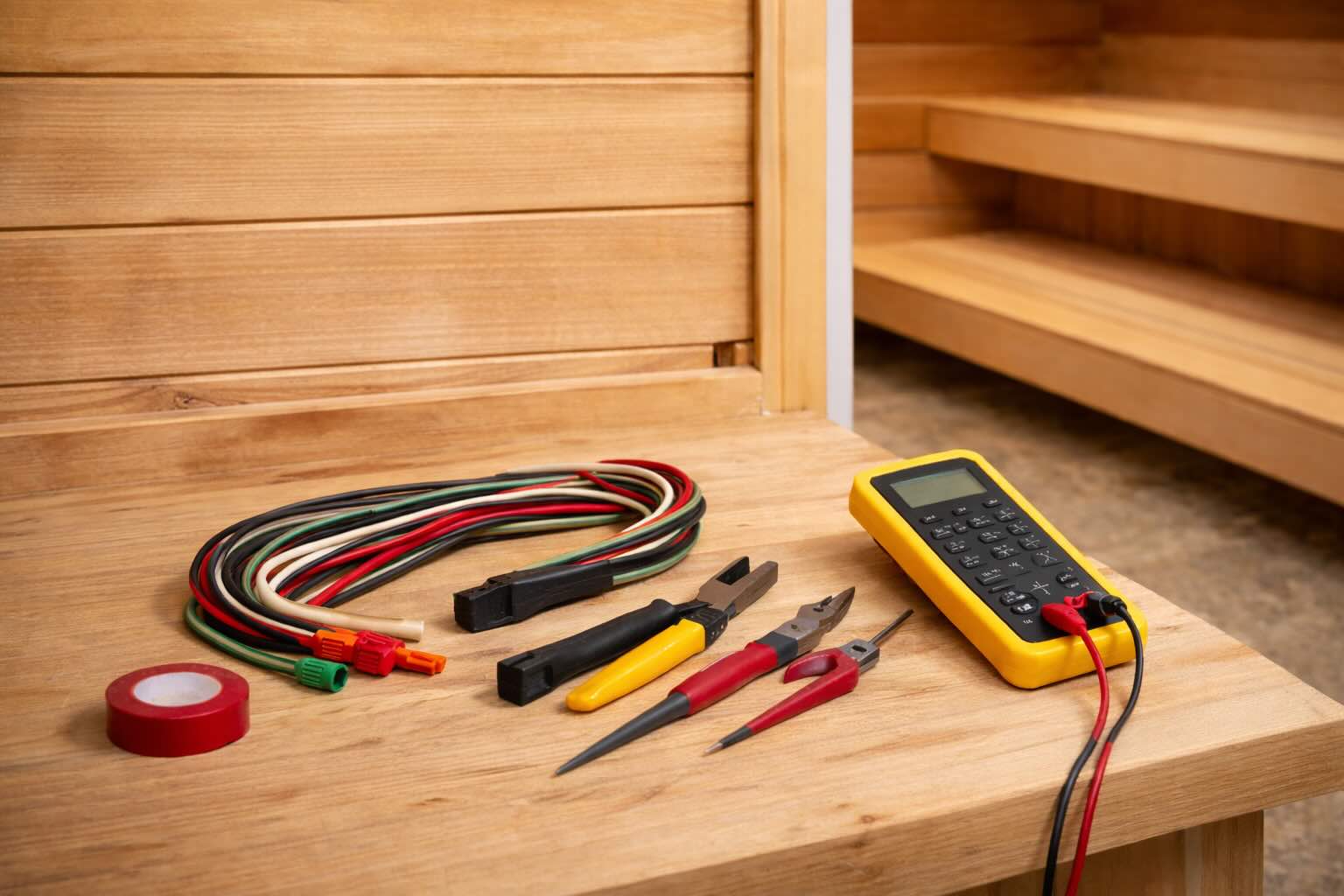
Wiring a sauna heater is not just a matter of getting power to the unit. A sauna heater is a high-load electrical appliance installed in a hot, moisture-prone environment. The circuit, breaker, conductor size, grounding path, controls, disconnect location, and manufacturer requirements all need to work together.
For most residential sauna installations, the heater will need a dedicated circuit from the electrical panel. Smaller 120-volt heaters may plug into a standard receptacle, but most traditional electric sauna heaters are 240-volt hardwired units with a dedicated breaker and properly sized conductors.
Important: This article is for homeowner education only. Sauna heater wiring should be completed by a licensed electrician and installed according to the heater manufacturer’s instructions, the National Electrical Code, and local requirements. In Washington, homeowners should also check current electrical permitting requirements through Washington L&I.
Start With the Sauna Heater Nameplate
The first thing an electrician looks for is the heater nameplate or installation manual. That information tells us the voltage, wattage, amperage, phase, control requirements, conductor requirements, and any manufacturer-specific installation rules.
For example, a 9,000-watt heater running on 240 volts draws about 37.5 amps before any code adjustments are considered. That number is the starting point for sizing the circuit.
| Heater Size | Voltage | Approximate Amp Draw | Typical Circuit Direction |
|---|---|---|---|
| 4.5 kW | 240V | 18.75 amps | Often a 30 amp circuit, depending on manufacturer instructions |
| 6.0 kW | 240V | 25 amps | Often a 30 or 40 amp circuit, depending on load calculation and manual |
| 8.0 kW | 240V | 33.3 amps | Often a 40 or 50 amp circuit, depending on continuous-load sizing |
| 9.0 kW | 240V | 37.5 amps | Often a 50 amp circuit after continuous-load sizing |
| 10.5 kW | 240V | 43.75 amps | Often requires a larger circuit and careful panel/load review |
These are planning examples, not final installation instructions. The final circuit size depends on the heater manual, conductor type, distance from the panel, temperature ratings, local code, and whether the installation requires a disconnect, subpanel, or control box.
Plug-In Sauna Heaters vs. Hardwired Sauna Heaters
Some small sauna heaters or infrared sauna units are designed for 120-volt plug-in use. These are usually lower-output units and may work with an existing receptacle if the circuit is properly rated and not shared with other major loads.
Most traditional electric sauna heaters are different. They commonly require a 240-volt dedicated branch circuit from the main panel or subpanel. That means no lights, receptacles, fans, or other equipment should be tied into the same heater circuit unless the manufacturer and code allow it.
If you are installing a premium custom sauna from BW Sauna Co., the electrical planning should happen before the sauna is finished. That allows the electrician, sauna builder, and homeowner to coordinate heater location, control location, conduit routing, wall penetrations, ventilation clearances, and access for future service.
Where the Controls Can Live
Sauna heater controls vary by model. Some heaters have built-in controls directly on the heater. Others use a wall-mounted digital control, a contactor box, or a separate control board located outside the sauna room.
This matters because the electrician may need to run more than one wiring path. A basic heater may only need a power feed to the unit. A more advanced system may require a power feed to a control box, wiring from the control box to the heater, a temperature sensor wire, and sometimes a door sensor or high-limit safety connection.
Many manufacturer instructions require low-voltage sensor wiring to be routed separately from higher-voltage conductors. Some also require the control box to be placed outside the sauna in a dry location. That is why the manual should be reviewed before walls are closed up.
Breaker Sizing Starts With Wattage and Amperage
The basic formula is simple:
Watts ÷ Volts = Amps
For a 9,000-watt heater on 240 volts:
9,000 ÷ 240 = 37.5 amps
But that does not automatically mean the heater can go on a 40 amp breaker. Sauna heaters can operate for long periods, so electricians often apply continuous-load sizing where required. Continuous-load rules commonly require the circuit to be sized at 125 percent of the load.
Using the same example:
37.5 amps × 125% = 46.875 amps
That pushes the circuit to the next standard breaker size, which is commonly 50 amps. This is why many 9 kW sauna heaters end up on a 50 amp circuit even though the raw math looks like 37.5 amps.
Wire Gauge Must Match the Breaker
The breaker protects the wire. If the breaker is too large for the conductor, the wire can overheat before the breaker trips. That is one of the most dangerous mistakes in any high-load circuit.
| Common Breaker Size | Common Copper Wire Direction | Important Note |
|---|---|---|
| 30 amp | Often 10 AWG copper | Final sizing depends on cable type, insulation rating, run length, and installation conditions. |
| 40 amp | Often 8 AWG copper | Common for mid-sized 240V sauna heaters when allowed by the manual and code. |
| 50 amp | Often 6 AWG copper | Common for larger heaters such as many 9 kW units after continuous-load sizing. |
| 60 amp and above | Requires specific conductor sizing | Often requires deeper panel capacity review and manufacturer-specific requirements. |
Wire size is not chosen by guesswork. The electrician has to consider the breaker size, conductor material, insulation temperature rating, whether the wiring is NM-B, THHN/THWN in conduit, or another approved wiring method, the length of the run, voltage drop, bundling, ambient temperature, and local inspection requirements.
What Happens If the Breaker Is Undersized?
If a 9,000-watt heater pulls about 37.5 amps and it is placed on a 30 amp breaker, the breaker will likely trip. That is not the breaker being “bad.” It is doing its job.
A breaker is designed to interrupt the circuit when the load exceeds what that circuit is rated to carry. If the sauna heater is too large for the circuit, the correct solution is not to keep resetting the breaker. The correct solution is to evaluate the full circuit and install the proper breaker, wire size, control equipment, and grounding path.
Do not simply upsize the breaker to stop tripping. If the existing wire is only rated for a smaller circuit and someone installs a larger breaker, the wire can overheat. On a sauna heater circuit, that is especially dangerous because the load is high and may run for long periods.
Grounding, Bonding, and Outdoor Sauna Feeds
Every sauna heater circuit needs a proper equipment grounding conductor. Grounding gives fault current a safe, low-resistance path back to the source so the breaker can trip quickly during a fault.
This is especially important for outdoor saunas, detached sauna buildings, mobile saunas, and installations where wiring passes underground. If wiring is routed underground, conduit may be used to protect the conductors from soil, moisture, rocks, shifting ground, and future digging.
For underground protection, HDPE conduit can be a practical option because high-density polyethylene is durable, corrosion-resistant, flexible, and commonly used to protect electrical and communication cables underground. Legacy HDPE is a useful resource when discussing HDPE material properties, pipe durability, and why HDPE performs well in harsh underground environments.
However, HDPE pipe or conduit is not the ground. It protects the conductors. The electrical system still needs a properly sized equipment grounding conductor installed according to code. In other words, an HDPE conduit run may protect the wire, but the copper or approved grounding conductor is still what provides the electrical fault path.
Panel Capacity Matters
A sauna heater is often one of the larger loads in a home. Before adding a 40 amp, 50 amp, or larger sauna circuit, an electrician should review the panel capacity and the home’s existing electrical loads.
This is especially important if the home already has large electrical loads such as an electric range, electric dryer, heat pump, EV charger, hot tub, or standby generator connection. In some cases, a sauna can be added cleanly. In other cases, the panel may need reorganization, a subpanel, a service upgrade, or load management.
For homeowners in Southwest Washington, MAS Pro Service can help evaluate the existing panel and determine what is needed before the sauna heater is installed.
Permits and Inspection
Most sauna heater installations involve new electrical work, especially when a dedicated 240-volt circuit is required. That typically means a permit and inspection may be required by the local authority having jurisdiction.
In Washington, electrical permitting and inspection rules are handled through Washington State Labor & Industries or the applicable local electrical inspection authority. A licensed electrician can help determine what permit is required and make sure the installation is ready for inspection.
Common Sauna Wiring Mistakes
- Installing a sauna heater on a shared circuit instead of a dedicated circuit.
- Using a breaker that is too small for the heater load.
- Upsizing the breaker without upsizing the wire.
- Failing to follow the heater manufacturer’s wiring diagram.
- Routing control or sensor wiring incorrectly.
- Skipping the equipment grounding conductor on an underground or detached sauna feed.
- Installing controls inside the sauna when the manufacturer requires them outside the room.
- Failing to check panel capacity before adding a large 240V heater load.
How MAS Pro Wires Sauna Heaters Safely
At MAS Pro Service, we approach sauna heater wiring as a full electrical installation, not just a simple hookup. We review the heater specs, calculate the load, check the panel, size the breaker and conductors correctly, route the wiring cleanly, install grounding properly, and follow the manufacturer’s requirements for controls and safety devices.
We also understand that sauna projects often involve more than one contractor. If you are working with a sauna builder like BW Sauna Co., the best results happen when the electrical plan is coordinated early. That way, the heater, benches, controls, conduit, access points, and finished woodwork all come together cleanly.
For electrical planning, wiring, panel work, EV chargers, generators, and high-load residential circuits in the Vancouver and Clark County area, homeowners can also learn more from Wires R Us, another electrical resource focused on safe, professional residential electrical work.
Need Help Wiring a Sauna Heater?
MAS Pro Service can help size the circuit, review your panel, install the proper breaker and wire, and make sure your sauna heater is connected safely. If you are planning a new sauna, remodeling an existing space, or adding an outdoor sauna, contact MAS Pro before the walls are closed and before the heater arrives.
Contact MAS Pro Service to schedule electrical service.