Skip to content
Vancouver House Fire Tied to Outdated Electrical Panel: What 1980s-Era Homeowners Need to Know
The short version: A recent Vancouver, WA house fire on 155th Avenue was traced to an overloaded circuit inside an outdated electrical panel, according to the Vancouver Fire Marshal. If your home was built in the 1970s or 1980s and still runs on its original breaker panel, that panel may share the same documented failure pattern: breakers that trip during short circuits but fail to trip during sustained overloads. Replacement is the only reliable fix.
What the Vancouver Fire Marshal Confirmed
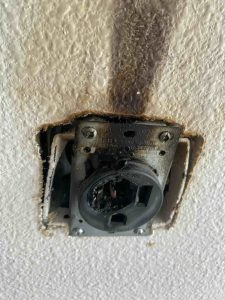
On May 26, 2026, the Vancouver Fire Department publicly reported that a house fire on 155th Avenue was caused by an overloaded circuit inside an electrical panel installed during the 1980s. According to the official statement, the panel involved is a model that has been widely documented to trip reliably during a short circuit but to fail under sustained overcurrent, where the wires behind the wall heat up over time and ignite the surrounding structure.
The Fire Marshal’s direct recommendation was straightforward: if your home was constructed in the 1980s, you should check your breaker panel.
That advice applies to a large share of housing stock across Clark County. Vancouver, Salmon Creek, Hazel Dell, Orchards, Five Corners, and surrounding neighborhoods all experienced significant residential construction during that era, and a meaningful number of those homes still operate on their original electrical service.
Why Some 1980s Panels Are a Documented Fire Hazard
Several brands of electrical panels manufactured in the late 1970s through the 1980s have been the subject of recalls, lawsuits, insurance carrier warnings, and decades of independent testing that demonstrated a consistent failure mode. The mechanism is the same in each case:
A breaker is designed to do two things. First, it cuts power instantly when a short circuit happens, the kind of dramatic failure where two wires touch and current spikes in milliseconds. Second, and arguably more important for fire prevention, it cuts power when a circuit is drawing more current than it was designed to carry for a sustained period. That second job, the slow overload trip, is where the documented failures occur. The breaker holds, the wires keep heating, and eventually insulation breaks down inside the wall.
The Vancouver incident on 155th Avenue is consistent with that pattern. The breaker did not stop the overload. The fire started.
This Is Not a Theoretical Risk
Insurance carriers in Washington and across the country have refused to write policies on homes with certain identified panel models, or have required replacement as a condition of coverage. If your homeowner’s policy is up for renewal and your panel is the original from the era, an inspection now is far less expensive than a denied claim or a forced last-minute replacement.
Signs Your Panel May Be the Problem
You do not need to be an electrician to spot the warning signs. Walk down to your panel and look for the following.
If the house was built between 1975 and 1990 and the panel does not look obviously newer than the rest of the home’s electrical work, assume it is original until proven otherwise.
A panel that has run for decades without a single trip during heavy appliance use is not necessarily a sign of a healthy system. It can be a sign that the breakers are not doing their second job.
A breaker should feel cool to the touch. Warmth, brown discoloration, or a faint burnt smell near the panel is a serious warning sign and warrants immediate attention.
Especially when the dryer, oven, or HVAC system kicks on, persistent dimming or flickering points to a panel that is no longer keeping up with the home’s load.
A panel should be silent. Any audible noise from inside the box is a reason to stop using affected circuits and call a licensed electrician the same day.
If you can see damage with the cover off, the panel is past the point of repair. The right move is replacement, not a service call to swap a single breaker.
What Vancouver Homeowners Should Do This Week
The Vancouver Fire Department’s recommendation was to check your panel. For most homeowners, that check happens in three steps.
Step 1: Identify your panel
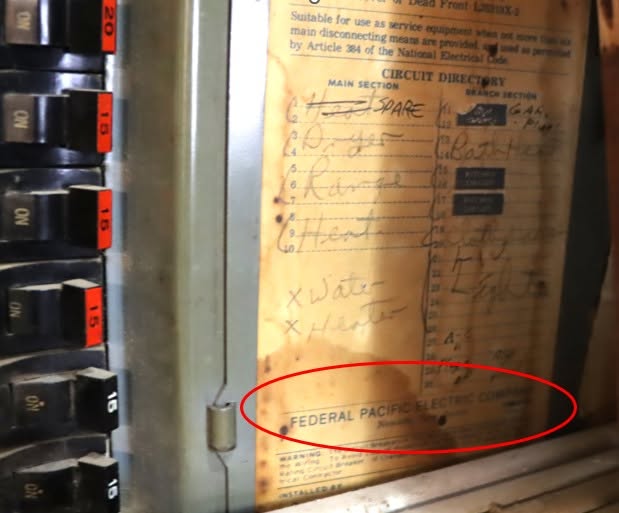
Open the panel door. The brand name and model are usually printed on the inside of the door or on the directory card. Take a clear photo. If you live in a home built between 1975 and 1990 and you are unsure whether your specific panel is one of the documented problem models, that photo is what an electrician needs to give you a straight answer.
Step 2: Get a licensed inspection
An inspection from a licensed electrical contractor takes under an hour for a typical residential panel. The electrician will identify the manufacturer, the model, the amperage rating, and any visible signs of failure. In Washington, electrical work is regulated by the Department of Labor and Industries (L&I), and any contractor working on your panel should be licensed and bonded through that agency.
Step 3: Plan the replacement if needed
If the panel is one of the documented problem models, replacement is the right path. A modern 200-amp panel installation in Clark County typically takes a single day, requires a county permit, and resolves the underlying fire risk along with adding capacity for modern loads like EV chargers, heat pumps, and induction ranges. We have written a more detailed resource on recalled electrical panels and how to identify them, which goes into the specific brands and model series that homeowners and inspectors flag most often.
Concerned About Your Panel? Get It Inspected.
MAS Pro Service has been doing electrical work in Clark County since 2017 and runs a fully licensed electrical division. If your home is from the 1970s or 1980s and you want a clear answer on whether your panel is safe, we will come out, inspect it, and tell you what we see. No pressure, no upsell.
Call (360) 907-3412How an Old Panel Connects to Modern Electrical Loads
One thing worth flagging for homeowners researching this topic: even if your 1980s panel were operating exactly as designed, it was sized for the electrical loads of a 1980s household. A typical home from that era ran a refrigerator, a furnace blower, a water heater, lighting, and a few small appliances. That is it.
A modern household runs all of that plus a heat pump, an EV charger, an induction or electric range, a microwave, a dishwasher, a washing machine, a dryer, a tankless water heater in some cases, multiple bathroom fans, server racks for home offices, and the entire ambient draw of dozens of always-on electronics. The load profile is not even close to comparable.
That means a panel from 1985 is often being asked to carry roughly double the sustained current it was designed for. When you combine that with a known weakness in the breaker’s overload response, the math becomes uncomfortable. The 155th Avenue fire is what that math looks like when it goes wrong.
Permits, Licensing, and What to Look For in a Contractor
Any electrical panel replacement in Clark County requires a permit pulled through the county or, if you are inside the city limits, through the City of Vancouver. The contractor doing the work should be licensed through Washington State L&I, bonded, and insured. Ask for the L&I number before signing anything. A legitimate contractor will not hesitate to provide it.
For panel work specifically, you also want to confirm that the electrician will coordinate the utility power shutdown with Clark Public Utilities, that they will pull the permit themselves rather than ask you to pull it as a homeowner, and that the work will be inspected by L&I after completion. Skipping the inspection is the single most common shortcut taken by unlicensed operators, and it is also the one that creates the biggest problems at resale or insurance renewal.
Frequently Asked Questions
Open your panel door and look for the manufacturer name on the inside cover or directory card. If your home was built between 1975 and 1990 and the panel is original, take a photo of the label and have a licensed electrician identify it. Several brands from that era have documented overload failure issues, and a quick visual inspection can tell you whether yours is one of them.
A typical residential panel replacement in Clark County, including the permit, the new 200-amp panel, the labor, the utility coordination, and the L&I inspection, generally runs in a predictable range that depends on whether the service entrance, meter base, and grounding system also need updating. The best way to get a real number for your home is an on-site quote, which MAS Pro provides at no cost.
Generally no, but the relationship between insurance carriers and older panels is worth understanding. Many carriers will not write or renew policies on homes with certain identified panel models, and some require replacement as a condition of coverage. Replacing the panel proactively can prevent a denied renewal or a coverage gap.
For a standard residential replacement in Vancouver or Clark County, the work itself takes one day on site. Power is shut off through Clark Public Utilities for several hours during the swap, the permit is pulled in advance, and the L&I inspection is scheduled for shortly after. Most households are back on full power the same evening.
For the documented problem panels from the late 1970s and 1980s, the issue is the panel design itself, not just the individual breakers. Replacement breakers from the same era share the same failure pattern, and the bus bars and panel housing also age out. A full panel replacement is the only reliable fix.
Panels installed after roughly 1990 are generally outside the documented problem era, though that is not a guarantee. If you are seeing warm breakers, flickering lights, buzzing sounds, or have an unusually high modern load on an older 100-amp panel, an inspection is still worthwhile regardless of construction year.
Reporting on the May 26, 2026 incident on 155th Avenue in Vancouver, WA is based on the public statement issued by the Vancouver Fire Department through the Vancouver Fire Marshal’s office. MAS Pro Service is a licensed electrical, plumbing, and HVAC contractor serving Clark County and Cowlitz County, Washington.