Skip to content
Summer Electrical Upgrades in Vancouver, WA: The June 30 EV Charger Deadline, Plus Hot Tubs, RV Outlets, AC, and Generators
The short version: If you are planning a summer electrical project in Vancouver, WA or anywhere in Clark County, the most time-sensitive piece is the federal EV charger tax credit, which is currently scheduled to expire on June 30, 2026. After that, the 30 percent federal credit (up to $1,000 for residential installs) goes away. Clark Public Utilities also runs its own EV charger rebate, hot tubs and RV outlets need dedicated circuits sized correctly, and AC, heat pump, and generator demand peaks every July and August. The planning window is now.
Why Summer Is the Heaviest Electrical Planning Season in Clark County
Every year between roughly May and September, Vancouver-area homeowners pile a stack of electrical projects onto already-loaded panels. The pattern is consistent. The hot tub gets installed in time for the kids being out of school. The RV gets plugged into a new 50-amp pedestal before the first camping weekend. The AC starts running for the first real summer heat wave and a homeowner notices that the breaker is warm. The EV gets bought because gas prices spike and the buyer realizes there is no Level 2 charger at home. By August, every licensed electrical contractor in Clark County is booked two to four weeks out.
The smart move is to plan the work now, before that backlog builds. Below is a breakdown of the most common Vancouver summer electrical projects, what they involve, and what rebates or credits are actually available right now in 2026.
EV Charger Installation in Vancouver, WA: The Priority Project This Summer
What Makes EV Chargers Time-Sensitive Right Now
EV adoption in Clark County is well past the early-adopter stage. As of April 2024, the Washington Department of Licensing reported approximately 10,500 registered electric vehicles in Clark County, and that number has grown since. The bottleneck for most new EV owners is not the car itself, it is having a Level 2 charger at home that actually keeps up with daily driving.
Two things make summer 2026 specifically a window worth paying attention to.
1. The federal 30C tax credit ends June 30, 2026. The Alternative Fuel Vehicle Refueling Property Credit covers 30 percent of installation cost, up to $1,000 for residential, but only for systems placed in service before the end of June. After that, the credit goes away under current law. Clark County is a mix of urban and non-urban census tracts, and many addresses in Vancouver, Hazel Dell, Salmon Creek, Battle Ground, Ridgefield, Brush Prairie, and surrounding areas qualify. Your tax professional can confirm.
2. Clark Public Utilities runs its own EV charger rebate program that does not expire on June 30. Clark PUD currently offers a $500 rebate for the purchase and installation of a qualified Level 2 charger from the utility’s approved list, or a $100 rebate for the purchase and installation of any other Level 2 charger that meets the program’s basic requirements. Each household is eligible for up to two charger rebates. The utility also runs a separate $50 credit pilot program for EV owners who agree to charge during off-peak hours.
Stacking the Numbers
For a homeowner installing a qualifying Level 2 charger before June 30, 2026, the stack looks roughly like this:
| Incentive | Amount | Notes |
|---|---|---|
| Federal 30C tax credit | Up to $1,000 | 30% of cost, residential, expires June 30, 2026, eligible census tracts |
| Clark PUD rebate (qualified L2) | $500 | Up to two per household, from approved product list |
| Clark PUD rebate (any L2) | $100 | Alternative to the $500 rebate for non-listed units |
| Clark PUD off-peak charging pilot | $50 credit | For agreeing to charge during off-peak hours |
These programs have their own eligibility rules, and the exact final number for your install depends on the charger model, your home’s eligibility for the federal credit, and your utility account status. A licensed electrical contractor will not file your taxes for you, but we will give you a written invoice with the install details that your tax preparer needs to claim the 30C credit, and we can help you select a charger that lands on the Clark PUD approved list.
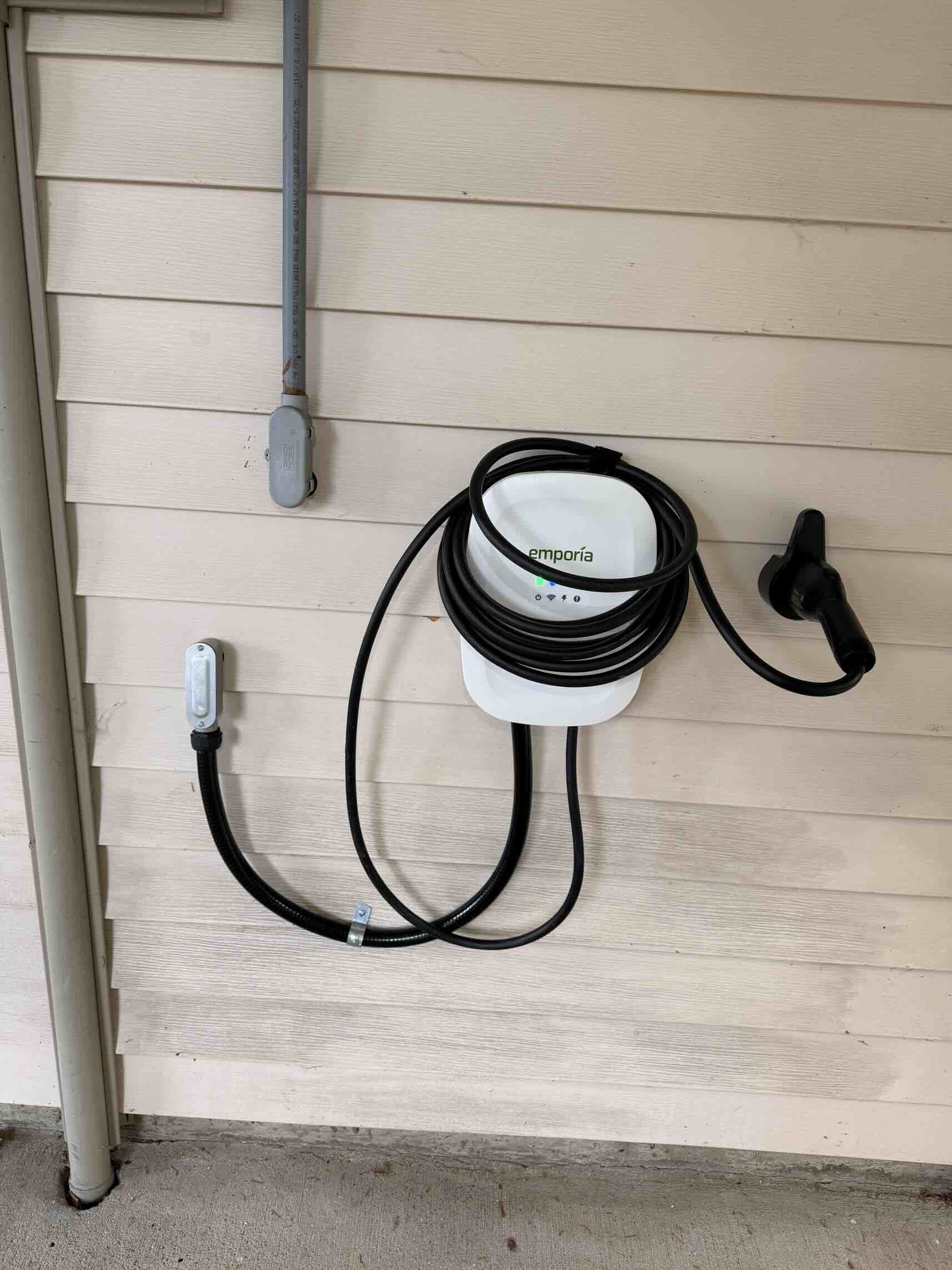
For a recent example of what an outdoor Level 2 install looks like on a Clark County home, see our recent Brush Prairie Emporia charger case study covering a three-hour install on exterior siding.
Hot Tub Circuits: The Most Common Summer Add-On
What a Hot Tub Actually Needs From Your Panel
A standard residential hot tub draws either 30 or 50 amps at 240 volts, depending on the unit. The install needs a dedicated circuit, a properly fused exterior disconnect within sight of the tub (this is a code requirement, not a preference), GFCI protection, and conductors sized for the run from the panel to the tub location. A weatherproof J-box or in-wall connection finishes the rough-in before the tub arrives.
The most common mistake we see is hot tubs plugged into existing outdoor outlets that were never intended to carry that load. The outlet may work for a season or two, but the wires behind the wall heat up under sustained current, the breaker eventually trips intermittently, and in the worst cases, you end up with a damaged outlet or worse. A proper dedicated hot tub circuit costs less than the repair work after that.
Permit and Timeline
Hot tub circuit installations require an electrical permit through Washington State Labor and Industries (L&I), which is the licensing authority for electrical work in Washington. A typical install on an accessible exterior wall takes a few hours plus inspection scheduling. On a longer run, particularly to a backyard tub with the panel on the opposite side of the house, expect a half-day to full-day depending on whether trenching is involved.
RV Outlets: 30-Amp vs 50-Amp, and What to Install
Sizing the Outlet to the Camper
Vancouver-area RV owners typically need one of two outlet types: a 30-amp TT-30R (common for travel trailers and smaller motorhomes) or a 50-amp 14-50R (for larger Class A motorhomes and fifth wheels with two AC units, washer/dryers, residential appliances). The wrong outlet means you cannot use the RV at home without an adapter, and adapters under sustained load are a common cause of melted plugs.
The right approach is to confirm the RV’s nameplate amperage before pulling the permit, install the matching outlet on a dedicated breaker, and locate the receptacle close enough to where the RV actually parks that you are not running cables across a driveway or sidewalk.
Where to Mount It
Most Vancouver and Clark County homeowners install RV outlets in one of three locations: on the exterior wall of the house adjacent to the RV parking pad, on a dedicated pedestal next to the RV pad, or on the exterior of a detached garage or shop. The right location depends on where the RV actually lives when it is home, how far that is from the existing panel, and whether the homeowner wants a permanent pedestal or a wall-mounted box.
On rural Clark County properties (think Brush Prairie, Battle Ground, Yacolt, La Center) where the RV pad is well away from the house, a pedestal install often makes more sense and pairs naturally with a 200-amp service upgrade if the existing panel is undersized.
AC, Heat Pumps, and Summer Cooling Capacity
What Vancouver Homes Need to Handle Summer Heat
Pacific Northwest summers are no longer mild. Vancouver, WA regularly sees stretches of 90-degree days in July and August, and the 2021 heat dome that hit Clark County made clear that homes built without active cooling were the most vulnerable to extreme heat. For a deeper breakdown of whether a heat pump or a traditional furnace-plus-AC setup is right for your home, see our companion piece on heat pumps versus furnaces in Vancouver, WA.
The piece of this that lives on the electrical side is panel capacity. A modern heat pump system, an electric AC condenser, or both, all draw real current. On older 100-amp panels common in Vancouver homes built before 1990 in neighborhoods like Hazel Dell, Five Corners, and Minnehaha, adding a cooling system can push the panel past its comfort zone. The electrical assessment is part of any honest HVAC quote.
Federal and Local Heat Pump Incentives Still Available
Unlike the EV charger credit, the federal 25C Energy Efficient Home Improvement Credit for ENERGY STAR certified heat pumps remains available in 2026, with up to $2,000 in credit on qualifying installations. Clark Public Utilities currently offers rebates ranging from $800 to $2,000 on qualifying ductless and ducted heat pumps installed in electrically heated homes. The exact rebate depends on the equipment selected and your home’s existing heat source.
Generators: The Project Most Vancouver Homeowners Underweight
Summer Outages Are Not Just a Winter Problem
Most homeowners think of backup generators in the context of January ice storms. The reality in Clark County is that summer outages happen too, especially during high-load periods when grid demand spikes, during windstorms that knock down branches onto power lines, and during planned utility maintenance windows.
A standby generator install involves the generator pad and unit, a transfer switch (manual or automatic), proper gas or propane connections if applicable, and a permitted electrical tie-in to your panel. For homeowners in outlying parts of Clark County, including Yacolt, Amboy, La Center, and the rural edges of Battle Ground, a standby generator pays for itself the first time you keep the freezer, the well pump, and the AC running through a multi-day outage.
This is also the one project where summer is the right time to start the planning, because permit timelines, equipment lead times, and inspection scheduling all stack up the closer you get to the fall storm season. Calling in June or July to install in August or September is dramatically less stressful than calling in October when the first windstorm has already happened.
Putting It All Together: One Service Visit, Multiple Projects
The single most cost-effective approach we see Vancouver and Clark County homeowners take is bundling related projects into a single mobilization. If your panel is going to be opened up to add a hot tub circuit, that is also the right time to add the RV outlet, the EV charger circuit, and the dedicated outdoor receptacle you have been meaning to install. You pay one permit fee, one trip charge, and one set of utility coordination steps instead of three or four separate service calls spread across the summer.
On homes with older panels, particularly 100-amp panels from the 1980s, the bundle often includes a 200-amp service upgrade as the first step. That single project unlocks every other circuit add-on without nuisance trips or load problems later.
- EV charger + hot tub disconnect + dedicated outdoor outlets on existing 200A service
- 200A service upgrade + EV charger + RV outlet (older home, full electrical refresh)
- Heat pump electrical tie-in + EV charger + panel load assessment
- Generator + transfer switch + outdoor receptacles (storm prep bundle)
- Hot tub circuit + 50A RV outlet + exterior lighting (recreation-focused properties)
Plan Your Summer Electrical Work Before the Backlog Builds
If you are looking at an EV charger install before the June 30 federal tax credit deadline, a hot tub circuit before the kids get out of school, an RV outlet before the first camping trip, or all three on the same visit, the planning window is now. We will come out, look at your panel, walk the property, and give you a real number on the projects you actually want done.
Call (360) 907-3412Frequently Asked Questions
Under current federal law, the Alternative Fuel Vehicle Refueling Property Credit (IRS Section 30C) for residential EV charger installations is scheduled to end for systems placed in service after June 30, 2026. The credit is worth 30 percent of cost up to $1,000 for residential, and applies only to homes in qualifying low-income or non-urban census tracts. Confirm eligibility with a tax professional, because the specific census tract rules matter.
Generally yes. The Clark PUD rebate is administered by the utility, while the federal 30C credit is administered through your federal tax return. They are separate programs with separate eligibility rules. Confirm with both Clark Public Utilities and your tax professional for your specific situation.
A 30-amp RV outlet (TT-30R) supplies 120 volts and handles smaller travel trailers and motorhomes with one AC unit and basic appliances. A 50-amp RV outlet (14-50R) supplies 240 volts split across two 120-volt legs and handles larger motorhomes and fifth wheels with two AC units or residential appliances. Check the RV’s nameplate amperage before installing the outlet, and match the install to the RV.
Yes. Hot tub circuit installations are electrical work that requires a permit pulled through Washington State Labor and Industries. The permit covers the dedicated circuit, the GFCI protection, and the exterior disconnect. A licensed electrical contractor pulls the permit and schedules the L&I inspection after the work is complete.
An honest answer requires a load calculation. A licensed electrician opens the panel, looks at the existing breakers, calculates the connected load and the demand load using the standard NEC method, and compares that to your panel’s rated capacity. If the math is tight, a service upgrade is the right first step. If there is headroom, the new circuit can be added directly.
For straightforward projects (single circuit add-on, EV charger install on an existing panel with capacity), one to two weeks of lead time is usually workable in early summer. By July and August, that stretches to three to four weeks or longer as the backlog builds. For projects requiring a service upgrade or utility coordination with Clark Public Utilities, expect to plan three to six weeks ahead regardless of season.
Yes. MAS Pro runs licensed electrical, plumbing, and HVAC divisions, which means a project that touches multiple trades (hot tub plus electrical, heat pump plus panel work, generator plus gas line) is handled by one company instead of three. We have been doing trades work in Clark County since 1987 and our electrical division launched in 2024.
Rebate and tax credit information referenced in this article is based on publicly available program documentation from Clark Public Utilities and the IRS Section 30C Alternative Fuel Vehicle Refueling Property Credit as of June 2026. Program terms, eligibility requirements, and deadlines can change. Confirm current details directly with Clark Public Utilities (Energy Services: 360-992-3355) and a qualified tax professional before relying on any specific number for your project. MAS Pro Service is a licensed electrical, plumbing, and HVAC contractor serving Clark County and Cowlitz County, Washington.