Skip to content

Most homeowners picture the ground wire as a drain that carries stray electricity into the dirt under the house. That is not its job. Its real work is to shove enough current back to your panel to trip the breaker before anyone gets hurt.
That distinction changes what a bad ground costs you. A house with weak or missing grounding does not just have a small safety gap. It has circuits where a fault can sit there energizing metal, waiting for someone to touch it, with nothing telling the breaker to shut off.
Here is how grounding really works, what to look for in your own home, and where we see it go wrong on service calls around Clark County.
Two wires get called the ground wire
People use “ground wire” for two completely different conductors, and mixing them up is where most of the confusion starts.
The equipment grounding conductor is the one in your walls. It is the bare copper or green wire running alongside the black and white conductors in every modern circuit. It bonds the metal parts of your system together: outlet yokes, metal boxes, appliance housings, light fixture canopies, your dishwasher frame. Under normal operation it carries no current at all.
The grounding electrode conductor is the one that goes into the earth. It runs from your service equipment out to ground rods, a metal underground water pipe, or rebar in the footing. There is usually one per house, and it has nothing to do with tripping breakers.
Both are required, and they do different jobs. Knowing which one you are talking about is the difference between a useful conversation with your electrician and a guessing game.
What does a ground wire do?
When a hot conductor comes loose and touches something metal, that metal becomes energized. If the equipment grounding conductor is connected, that fault current has a low resistance path straight back to the neutral bond at your service. Current spikes, the breaker sees a fault far above its rating, and it opens, usually in well under a second.
If the ground path is missing, broken, or high resistance, the fault current has nowhere good to go. The breaker never sees enough current to trip. The metal stays live. Nothing looks wrong until a person, a pet, or a bare foot on a concrete floor completes the circuit.
That is the whole point of grounding. It is not a drain. It is a trigger.
| Conductor | Color | Carries current normally? | Job |
|---|---|---|---|
| Hot | Black, red, blue | Yes | Delivers power to the load |
| Neutral | White or gray | Yes | Returns current to complete the circuit |
| Equipment ground | Bare copper or green | No | Gives fault current a path back so the breaker trips |
Is a neutral wire the same as a ground wire?
No, and this is one of the more common DIY mistakes we find in older Clark County homes.
The neutral is a working conductor. Under normal operation it carries the same current as the hot, just headed the other direction. The ground carries nothing until something breaks.
They are bonded together at exactly one place in a typical home, at the main service. Everywhere downstream of that point they stay separate. When somebody bonds neutral and ground at a subpanel, or lands both on the same terminal in a receptacle box, they create parallel paths for normal current. Now your ground wires and metal boxes are carrying load current all day. It works right up until it does not.
If you have ever opened a panel and seen white and bare wires sharing a bar in a subpanel, that is worth a call. It is one of the things we correct during an electrical panel replacement.
How to check if your outlets are grounded
Start with the easy visual. Grounded receptacles have three slots, including the rounded D shaped hole. Two slot receptacles have no equipment ground.
The catch is that three slots prove nothing. Swapping a two prong receptacle for a three prong on a cable with no ground conductor takes about four minutes and no knowledge whatsoever, and plenty of people have done it. The result is an outlet that looks safe, accepts a grounded plug, and protects nothing. It is also a code violation.
A three dollar plug in tester will tell you whether a ground is present. What it will not tell you is whether that ground is a solid low resistance path or a corroded, half connected one that will not clear a fault. That takes a meter and someone who knows what reading to expect. If your problem is a breaker rather than a ground, our post on resistance in short circuits covers that side of it.
What color is a ground wire?
In residential work the equipment ground is bare copper or green insulated, sometimes green with a yellow stripe. Bare is what you find inside standard NM cable. Green shows up on fixture leads, appliance cords, and conduit installations.
Green is reserved. Nothing else in the system is allowed to use it, which is why an electrician can open a box and read it at a glance. If you find a green conductor being used as a hot or a switch leg, somebody took a shortcut, and you should assume there are others.
When did ground wires become standard?
Grounding requirements were phased into the code through the 1960s. That gives you a rough dividing line: houses built from the early 1970s on generally have grounded circuits throughout, and older houses are a mixed bag depending on what has been remodeled since.
Mixed bag is the operative phrase. We regularly find homes where the kitchen and bath were updated properly, the panel was replaced at some point, and the back bedrooms are still on original ungrounded cable. The age of the house tells you what to expect. It does not tell you what is there.
Older systems often come with a second issue attached. If your home has aluminum branch circuit wiring or an obsolete panel, grounding is usually only part of the conversation. Our overview of the types of electrical panels found in homes is a good starting point, our note on signs your panel needs an upgrade covers the warning signs, and the electrical panel recall list and our page on Federal Pacific panels cover the brands we treat as replace on sight.
What if there is no ground wire at a light fixture?
If the box is metal and that box is grounded, the fixture is very likely grounded through its mounting hardware, and that is an acceptable arrangement. The problem is the assumption. A metal box in an older home may be fed by ungrounded cable, in which case the box is not grounded either, and neither is your new fixture.
Check before you trust it. If the box is plastic and there is no ground conductor present, you have no equipment ground at that location, period. Metal fixtures in that situation are the ones worth worrying about. This comes up constantly on retrofits, and our lighting installation work includes pulling proper grounded circuits rather than working around what is there.
Does a ceiling fan need a ground wire?
Yes. Fans have a motor and a metal housing, both mounted overhead where people reach up into them. A motor winding fault with no ground path is exactly the scenario grounding exists for.
Fans also need a box rated for the weight and the vibration, which is a separate issue that gets skipped just as often. If the box in your ceiling was installed for a light fixture, it very likely is not fan rated. Our ceiling fan installation page covers both.
How to add a ground wire to an outlet
There are three real options, and only one of them grounds the circuit.
- Pull a new circuit. Run new cable from the panel to the location. This is the correct fix. It is also the most work, since it means getting into walls, ceilings, or crawlspaces. It usually happens alongside outlet installation work.
- Run a separate equipment grounding conductor to an approved point. Allowed in specific cases, and it depends entirely on what is accessible in your particular house.
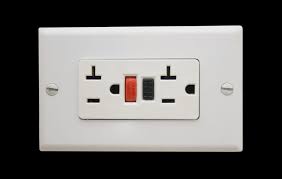
- Install a GFCI and label it No Equipment Ground. The code permits this as a replacement for an ungrounded two prong receptacle. Be clear on what you get: shock protection for people, no equipment ground for your equipment. Surge protectors and anything with a metal chassis are still working without a ground reference. Our post on how a GFCI works explains the difference.
If a house has enough ungrounded circuits, rewiring one at a time stops making sense and a broader plan is cheaper. That conversation usually starts with the panel and the service, and it falls under our residential electrical services. On some lots a single ground rod does not meet the code resistance threshold on its own, so a second rod or a supplemental electrode is added. That is a normal part of getting the grounding electrode right, not an upsell.
Where grounding matters most: chargers and standby power
Grounding gets more consequential as loads get bigger, and two jobs stand out.
Vehicle chargers. An EV charger is a large continuous load, often on an exterior wall or in an attached garage, feeding a conductive vehicle that people touch while it is connected. Equipment grounding at that circuit is not a detail. It is the whole safety case. If you are weighing options, start with EV charger installation.
Standby generators. A generator introduces a second source of power, and how neutral and ground are handled at the transfer switch depends on whether that source is separately derived. Get it wrong and you either have an unbonded system or unwanted current on your grounding conductors. This is the part of a generator job that homeowners never see and that inspectors look at first. See standby generator installation for how we approach it.
Quick answers
Does a ground wire carry electricity?
Not during normal operation. An equipment grounding conductor carries current only during a fault, and only long enough for the breaker to open.
Can I use the neutral as a ground?
No. They are bonded only at the service. Using a neutral as an equipment ground puts normal load current on grounding conductors and metal parts, which is both unsafe and a code violation.
Will a GFCI work without a ground?
Yes. A GFCI compares current on the hot and neutral and trips on the imbalance, so it protects people on ungrounded circuits. It does not provide an equipment ground.
Is a two prong outlet dangerous?
An ungrounded circuit is a real limitation rather than an emergency. The dangerous version is a three prong receptacle installed on ungrounded cable, because it hides the condition.
How do I know if my ground is any good?
A plug in tester confirms a ground is present. Confirming it is a low resistance path capable of clearing a fault requires test equipment and a licensed electrician.
Grounding is invisible when it is done right, which is exactly why it gets skipped, guessed at, and worked around. If you are opening up an older home, adding a large load, or you found something in a box that did not look right, have someone look at it who will tell you what is there. You can reach us through our contact page, and our full coverage is listed on the service area page.
Not sure whether your home is properly grounded? We will tell you what we find, in plain language.
Request a Visit