Skip to content
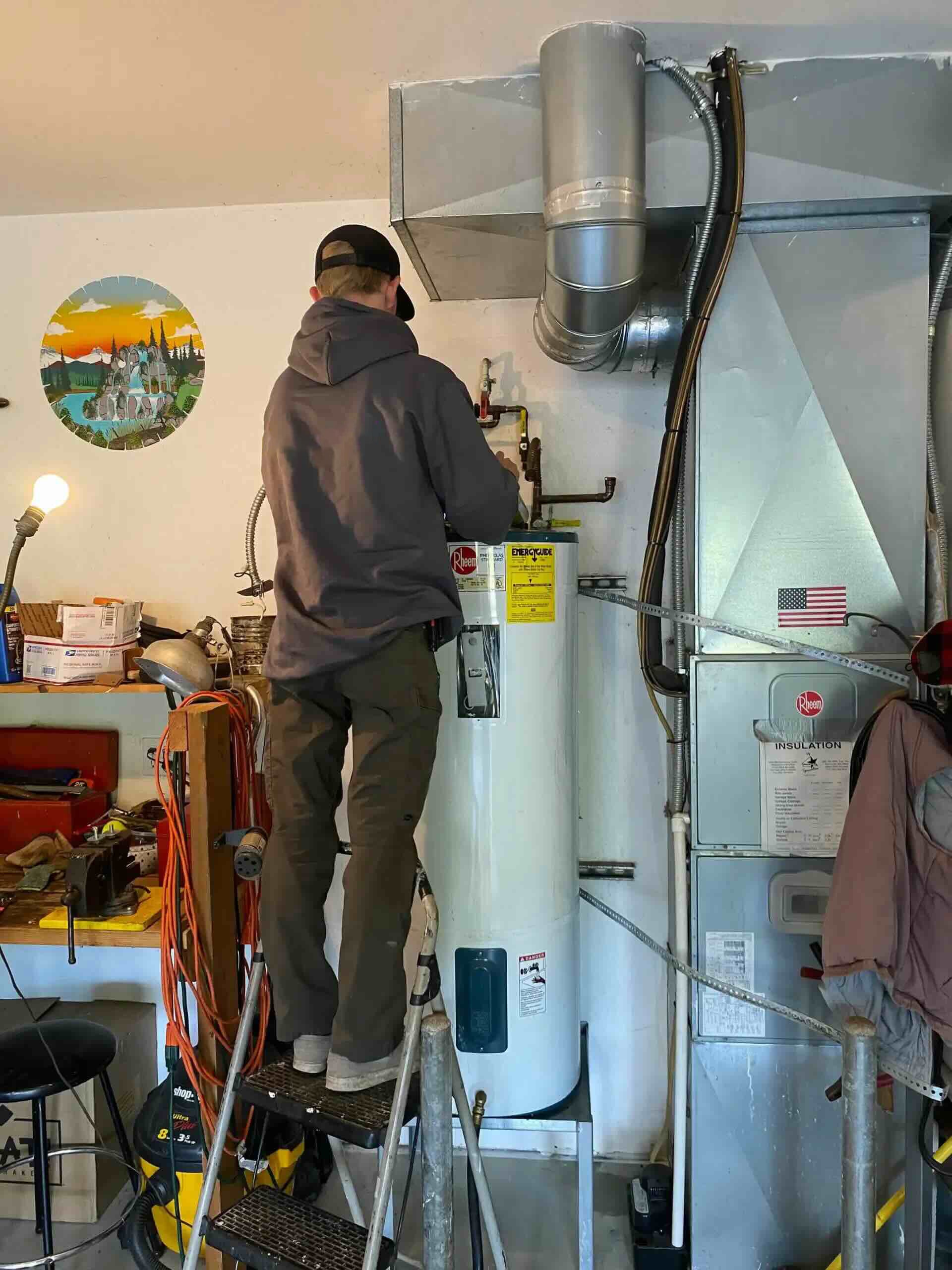
If you’re asking yourself, “what size water heater do I need?” the answer depends on your household size, hot-water use, and whether you’re considering a storage tank or tankless system. For homeowners in Vancouver, WA, local water quality can also affect maintenance needs and long-term performance. This guide explains how to size storage tank and tankless water heaters and maintain them.
Sizing a Storage Tank by First-Hour Rating
Storage tanks are sized two ways: by gallons of storage and by first-hour rating (FHR), which is how much hot water the unit can actually deliver during a busy hour. FHR is often more useful than raw tank size when comparing units. Start with household size, then adjust based on peak demand, such as a soaking tub or multiple showers.
| Household size | Typical tank capacity (gallons) | Target first-hour rating |
|---|---|---|
| 1 to 2 people | 30 to 40 | 30 to 40 gallons |
| 3 to 4 people | 50 to 60 | 50 to 60 gallons |
| 5 or more people | 60 to 80 | 60 to 80 gallons |
Table 1. General starting points for tank sizing. Actual requirements depend on peak-hour demand and the manufacturer’s FHR.
To estimate peak-hour demand more precisely, total the hot water you use during your busiest hour. A shower uses roughly 10 to 20 gallons, a dishwasher about 6, a clothes washer about 7 to 20, and shaving or hand-washing a few gallons each. Match a unit whose FHR meets or exceeds that figure to reduce the risk of running out of hot water during peak demand.
Sizing a Tankless Unit by Flow Rate
Tankless heaters are not sized by gallons of storage; they are sized by flow rate in gallons per minute (GPM) and by temperature rise. Temperature rise is the difference between your incoming water temperature and your target of roughly 120°F. Because Pacific Northwest inlet water is cold in winter, the required temperature rise is greater here than in warm climates, which means you should size up rather than down.
First, determine how many fixtures may run at once, then add their flow rates to find your peak GPM:
| Fixture | Typical flow (GPM) |
|---|---|
| Shower | 1.5 to 2.5 |
| Bathroom faucet | 0.5 to 1.5 |
| Kitchen faucet | 1.5 to 2.2 |
| Dishwasher | 1.0 to 2.5 |
| Clothes washer | 1.5 to 3.0 |
Table 2. Typical hot-water flow rates for common fixtures and appliances.. Add the ones you run simultaneously to find your peak GPM.
A single-bathroom home may need only 3 to 4 GPM for typical simultaneous use, while a busy household running two showers and another appliance at the same time could require 7 to 10 GPM or more.
A tankless unit’s advertised maximum GPM does not tell the whole story. That rating is based on a specific temperature rise, and the unit may deliver less flow when the incoming water is colder. That’s why tankless sizing should account for both your peak GPM and the temperature rise required by your home.
Why Water Hardness Matters in Southwest Washington
Water hardness is measured in grains per gallon (gpg) or parts per million (ppm) and primarily reflects the amount of dissolved calcium and magnesium in the water. Hardness varies throughout the Vancouver and Clark County area, so not every home has the same water conditions.
Harder water can contribute to mineral scale inside plumbing fixtures and water-heating equipment. Over time, mineral deposits and sediment can accumulate in a storage tank, particularly around the bottom and heating components.
Sediment can reduce heating efficiency and contribute to longer heating cycles, increased energy use, localized overheating, and premature wear. In gas water heaters, accumulated sediment can also contribute to the popping or rumbling sounds homeowners sometimes hear while the burner is operating.
If you notice unusual noises, reduced hot-water performance, or other signs of sediment buildup, professional inspection can help determine whether the tank needs to be flushed or serviced.
A Recommended Maintenance Routine
| Task | Frequency | Why it matters |
|---|---|---|
| Flush the tank | Once a year | Helps remove accumulated sediment and maintain heating efficiency |
| Inspect the anode rod | Every 1 to 3 years* | The sacrificial rod helps protect the steel tank from internal corrosion |
| Inspect the T&P relief valve | Annually | Helps verify that the safety valve and discharge piping are in good condition |
| Set thermostat to around 120°F | Set and verify | Helps reduce energy use and scald risk |
| Inspect for leaks and corrosion | A few times a year | Catches small problems before they cause flooding |
*The appropriate inspection interval varies by water quality, usage, and manufacturer recommendations. Replace the rod when it is significantly depleted.
Table 3. Core water heater maintenance tasks for homes with harder water.
Annual tank flushing helps remove accumulated sediment before it becomes a larger problem. The anode rod is your tank’s rust insurance. As the anode rod becomes significantly depleted, the tank loses an important layer of protection against internal corrosion. Replacing a depleted anode rod can be far less costly than replacing a prematurely corroded water heater. For homes with very hard water, a whole-home softener or scale-reduction system can extend the life of the water heater and other water-using appliances.
So, What Size Water Heater Do You Need?
As a general starting point, a 1- to 2-person household will often need a 30- to 40-gallon storage tank, while a 3- to 4-person household commonly needs 50 to 60 gallons. Larger households may need 60 to 80 gallons or more.
Household size alone doesn’t determine the right water heater; peak-hour demand, recovery rate, fixture usage, available space, energy source, and water quality all matter.
For tankless systems, focus on peak GPM and the temperature rise required to heat your incoming water to the desired temperature. Choosing a unit based only on its maximum advertised GPM can leave you with less hot water than expected during colder weather.
If you would prefer not to flush the tank yourself, or need help with installation and repair, contact the MAS Pro team.