Skip to content

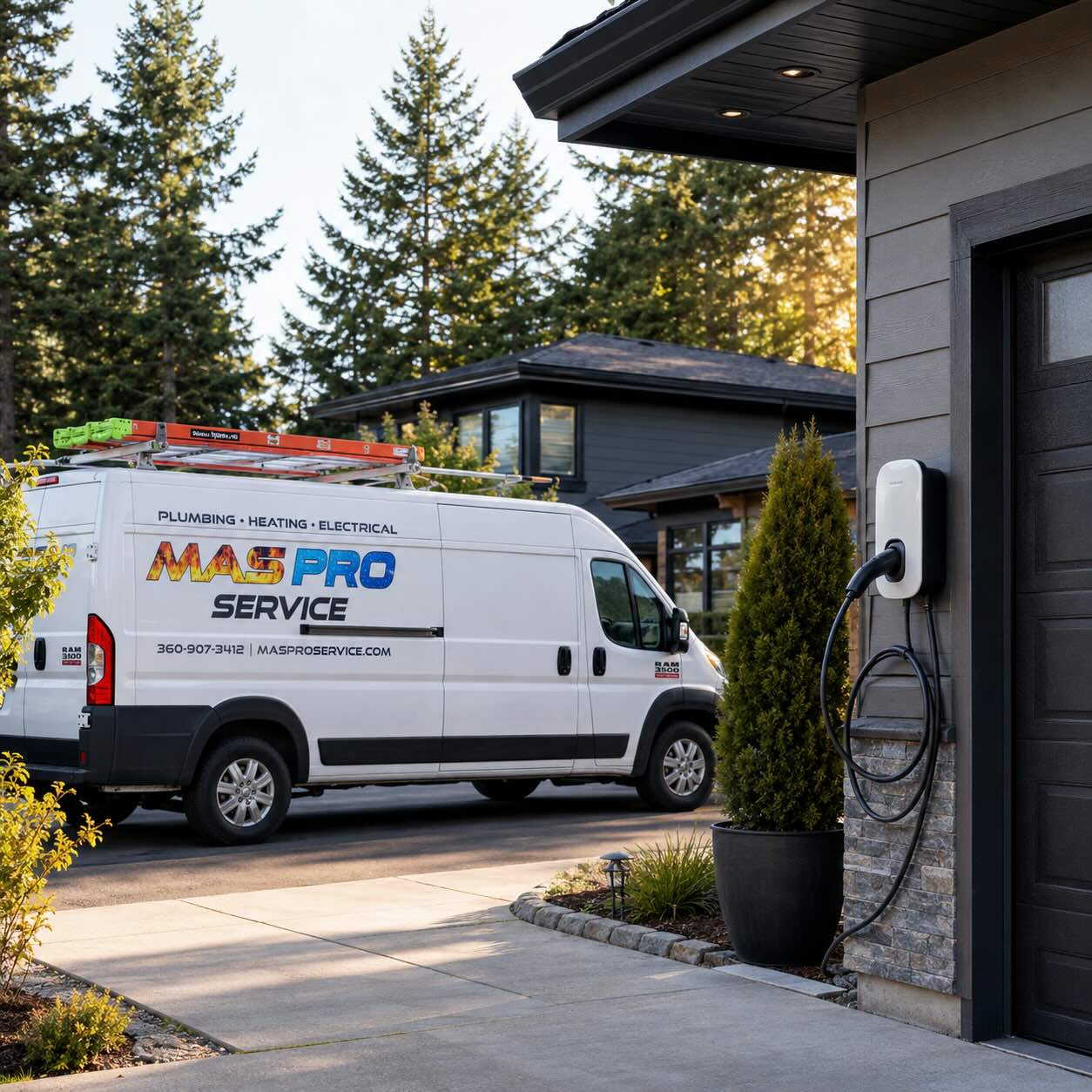
The electrical service in most homes was sized for a different life. A house wired a few decades ago was planned around a range, a dryer, a water heater, and lights. Then came heat pumps and central air, the hot tub, the shop, the backyard sauna, the second freezer, and now one of the biggest loads most homes have ever seen: electric vehicle charging. In Washington, where most homes already heat with electricity, that stack fills a panel faster than almost anywhere else in the country. The house did not change. What we ask of its panel did.
Here is what the federal data says about how much power homes use, how fast the big new loads stack up, and how to tell when a service in Vancouver or anywhere in Clark County is running out of headroom.
Where a Home’s Electricity Goes
The EIA’s Residential Energy Consumption Survey, the most detailed national study of household energy use, puts the average American home at about 10,566 kWh per year. The breakdown surprises people: it is dominated by a handful of big thermal loads, while the dozens of small devices everyone worries about are a rounding error by comparison.
Where the Average US Home’s Electricity Goes
Share of annual household electricity use by end use, national average.
| End use | Share of home electricity |
|---|---|
| Air conditioning | ~19% |
| Water heating | ~13% |
| Space heating | ~12% |
| Everything else (refrigeration, lighting, laundry, electronics, cooking) | ~56% |
Source: US Energy Information Administration, Residential Energy Consumption Survey. National averages. An all electric home in a heating climate like ours puts a far larger share into space heating.
Washington homes tilt even further toward those thermal loads. The average Washington home consumes about 955 kWh a month, or roughly 11,460 kWh a year according to EIA data. That’s above the national average despite our mild summers.
So many homes here run electric furnaces, baseboard heat, or heat pumps, but with the summers changing, Clark Public Utilities expect to shift from a winter peaking utility to a summer peaking one as air conditioning spreads across the county. Every major addition to a home in the last decade has been exactly the kind of load that makes heat or moves it.
The EV Is the Biggest New Load Since Central Air
Charging one electric vehicle at home adds roughly 3,000 to 5,400 kWh per year for typical driving, based on EIA and Department of Energy figures. Even against Washington’s higher baseline, that is a 26 to 47 percent increase on the home’s entire annual consumption from a single appliance. It is like bolting a second water heater and a second refrigerator onto the house and running them every night.
Annual Household Electricity Use in Washington, With and Without Home EV Charging
kWh per year. The amber segment shows the typical range added by one EV.
| Scenario | Approximate annual electricity use |
|---|---|
| Average Washington home | About 11,460 kWh |
| Average Washington home + one EV charged at home | Roughly 14,460 to 16,860 kWh |
Sources: EIA, average monthly residential consumption by state, 2024 (Table 5a); EIA and US Department of Energy estimates of home EV charging consumption for 12,000 to 15,000 miles of annual driving.
Energy over a year is one question. Power at a single moment is the other, and for your panel it is the one that counts. A Level 2 EV charger is commonly installed on a 40-to-60-amp, 240-volt circuit and runs for hours at a time as a continuous load. That is a different kind of demand than anything else in a typical house, and it is why the EV charger conversation so often turns into a service and panel conversation.
Try It: How Fast Does a Panel Fill Up?
Interactive: Stack the Big 240V Loads
Tap the loads a home might have, pick a service size, and watch the headroom disappear. Circuit sizes shown are typical installations.
The big 240V circuits alone now meet or exceed the service rating. In the real world this is where load management, a service upgrade, or both enter the conversation.
This is an illustration, and deliberately a rough one. Stacked breaker ratings are how a panel feels, but they are not how service sizing is done: real sizing uses a formal load calculation that accounts for which loads run at the same time. The point it makes is real, though. Modern 240V loads are large, there are more of them every year, and services sized for a previous era run out of practical room fast. A licensed electrician can run the real numbers for your home.
Signs a Home Is Outgrowing Its Service
- The panel is physically full: No open spaces left, or the panel has accumulated tandem breakers to squeeze more circuits in. You should never try to fix it by installing a bigger breaker on the same wire.
- Every new project triggers the same conversation: If the answer to “can we add a hot tub” or “can we add a charger” keeps being “it depends,” the service is the bottleneck.
- The house still has a 60A or 100A service: This is common in older Vancouver neighborhoods and rural homes around the county. The smaller services were workable for the loads of their era, but tight once modern 240V loads enter the picture. Older panels may also be on the electrical panel recall list.
- You are planning electric heat, an EV, a shop, a sauna, or an addition: Any one of these is a good moment to evaluate the service; two or more almost certainly is. Knowing how to wire a sauna heater is important if you’re planning to install a sauna.
Upgrading a service from 100A to 200A is routine work, and doing it ahead of the loads is dramatically easier than doing it in a rush. It pairs naturally with replacing an older panel that is past its prime, something we cover in common types of electrical panels explained. Buying a home? Check the service size before you close with what to look for in a home electrical system.
There is a bigger picture behind all of this. Homes are adding load at the same moment the Northwest grid is tightening, which we cover in what data centers mean for Clark County electric bills, and more electric heat means a winter outage hits harder, as the numbers in how often the power goes out in Clark County show.
Building New? Size for the Next Twenty Years, Not the Next Two
The cheapest electrical capacity you will ever buy is the capacity built in during construction. Washington’s 2021 energy code, in effect since March 15, 2024, steers new homes toward heat pumps for space and water heating, so new homes in Ridgefield, Camas, and Battle Ground start out more electric than the homes around them. When we walk a plan set before rough in, the conversation is exactly this list: the EV charger, the 240V garage circuits, the RV outlet, the hot tub and sauna circuits, conduit to the future shop. Wire and panel space cost little while the walls are open, and a great deal once they are closed. With homes using more electricity every year and the grid itself getting more expensive, oversizing the bones of a new home’s electrical system is one of the few construction decisions with essentially no downside. See our Clark County electrical services for new construction work.
Common Questions
How much electricity does the average Washington home use per month?
According to the EIA, about 955 kWh in 2024. Washington runs higher than the national average (863 kWh) because about every six in ten homes here are heated with electricity. All electric homes, larger homes, and homes with EVs, hot tubs, saunas, or shops run well above that.
Will my 100 amp service handle an EV charger?
Sometimes, and it depends on what else the home runs. A Level 2 charger is a large continuous load, and on a 100A service with electric heat, an electric range, and a dryer, there may not be room without load management or a service upgrade. The honest answer requires a load calculation for your specific home, which is quick work for a licensed electrician.
What is the difference between a panel swap and a service upgrade?
A panel swap involves replacing an aging, recalled or two-small panel while keeping the same service size. A service upgrade increases the overall amperage coming into your home and usually involves the meter base, service conductors, a new panel, coordination with Clark Public Utilities or Cowlitz PUD, and an L&I permit and inspection. Which one a home needs depends on whether the problem is space or capacity.
Is it worth oversizing the electrical service in a new build?
Almost always. It’s way cheaper to add a larger service, extra panel space, and a few spare conduits around the home during construction than once everything is already in place. New Washington homes are already built around heat pumps under the state energy code, and capacity built in now protects the home’s flexibility and resale value.
Is Your Service Ready for What’s Next?
MAS Pro Services handles panel replacements and service upgrades across Vancouver and Clark County, along with the EV chargers, heat pumps, hot tubs, and sauna circuits that drive them. We will give you a straight answer on what your home needs.
Plan Your UpgradeSources
- US Energy Information Administration, Residential Energy Consumption Survey (RECS), household consumption and end use data
- US EIA, average monthly residential consumption, price, and bill by state, 2024 (Table 5a)
- US EIA and US Department of Energy estimates of home EV charging electricity consumption
- US Census Bureau, American Community Survey, home heating fuel by state (2023); US EIA, electricity use for residential heating (2025)
- Clark Public Utilities, 2026 Integrated Resource Plan Progress Report
- Washington State Building Code Council, 2021 Washington State Energy Code adoption, effective March 15, 2024